
Introduction
A customer finds your bank. They compare products, choose you, click “Open an Account” and then they vanish.
This is not a rare scenario. It is the defining failure of digital banking today. Abandonment during the digital banking onboarding process is not just a UX inconvenience. it is a direct revenue drain, a wasted acquisition investment, and a signal your platform is working against itself. The customers who leave mid-onboarding do not disappear into a vacuum. They open an account somewhere easier.
The good news: this problem has known causes, proven fixes, and modern platforms built specifically to solve it. Here is what the data shows and exactly what to do about it.
The Real Scale of the Problem
The numbers are stark and rising year on year. According to Fenergo’s 2025 Financial Crime and Industry Trends Report, 70% of financial institutions reported losing clients due to inefficient onboarding a figure that has risen sharply from 48% in 2023 and 67% in 2024. That trajectory is not a blip. It is a growing structural problem across the industry.
The cost behind that number is just as significant. When your account for paid marketing, sales resource, brand investment, and the lifetime value of the customer who walked away, every abandoned application represents real money, lost before a single transaction is processed.
And yet most banks continue with onboarding flows built for an older era: multi-page forms, manual document uploads, opaque KYC waits, and zero save-and-resume capability. The mismatch between what modern customers expect and what most banks deliver is precisely what drives those abandonment rates.
Why the Digital Banking Onboarding Process Breaks Down
When applicants drop off, it is almost always traceable to one of these five friction points.
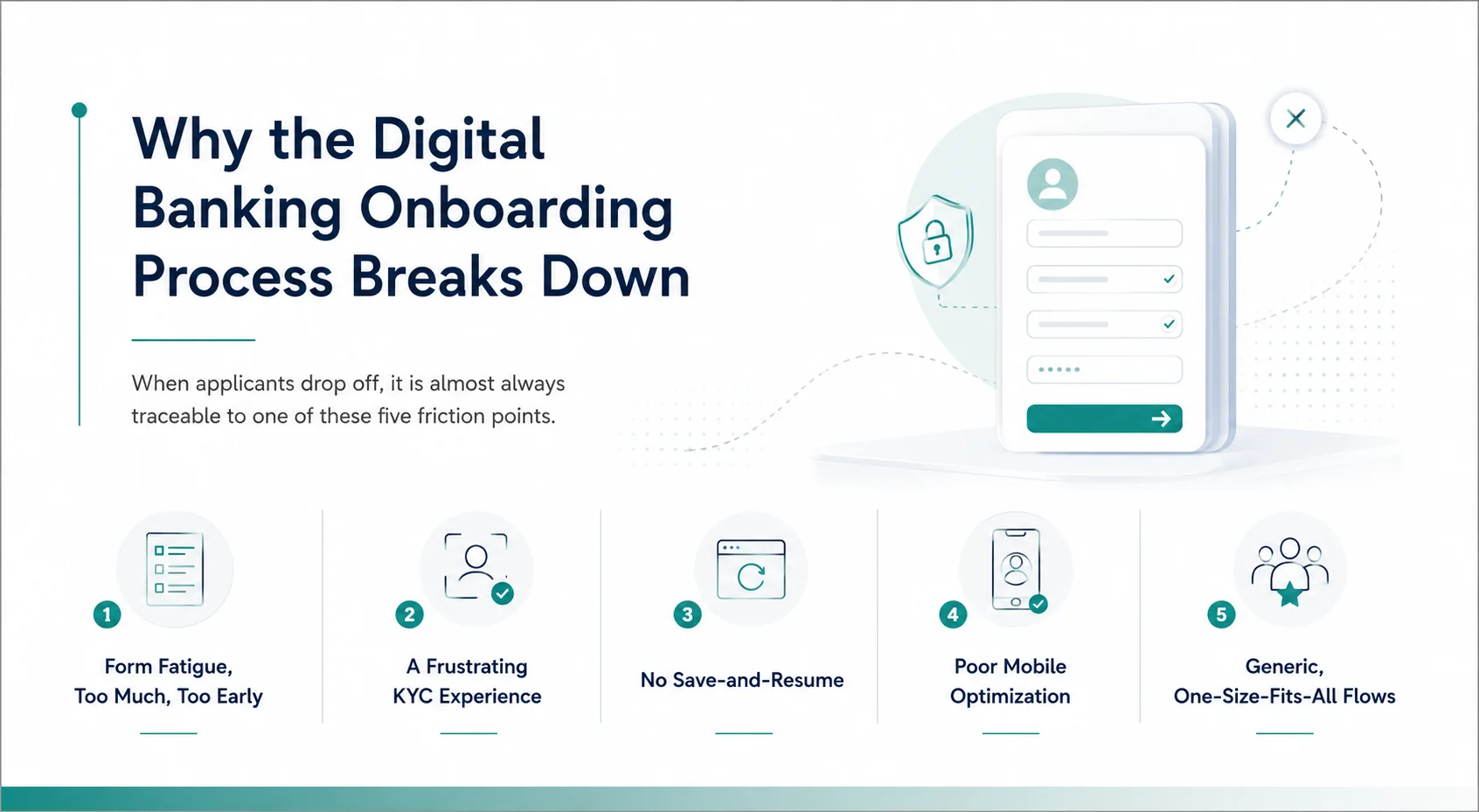
- Form Fatigue, Too Much, Too Early Banks ask for information that could be auto-populated, pre-filled, or verified silently in the background. Instead, applicants face screens of repetitive manual data entry. Research by Deloitte found that 38% of new customers abandon mid-onboarding specifically because the process demands too much information too soon. Every unnecessary field is a conversion leak, and most onboarding flows have dozens of them.
- A Frustrating KYC Experience Know Your Customer compliance is non-negotiable. But the way most banks implement it, disconnected document uploads, unclear instructions, long waits for manual review turns a regulatory step into a customer experience failure. PwC's research on perpetual KYC confirms that KYC costs now constitute approximately 3% of a bank's total operational cost base yet those same manual processes are simultaneously pushing away the customers that investment was meant to convert. Automating KYC is not just a UX improvement; it is a cost restructuring imperative.
- No Save-and-Resume Life interrupts. A customer starting an account application on their lunch break may not finish in a single sitting. If the platform clears their progress when they return, they either restart or abandon entirely. This single gap accounts for a meaningful share of mid-funnel drop-offs, and it is one of the simplest to fix with the right platform.
- Poor Mobile Optimization Mobile-first applicants the majority in most markets encounter flows built for desktop. Pinching, zooming, failed document captures, and poorly sized input fields compound into an experience that communicates institutional unreadiness. First impressions in digital banking onboarding are not recoverable.
- Generic, One-Size-Fits-All Flows A first-time account opener and a returning customer adding a product should not face the same 12-step journey. When onboarding lacks awareness of who the applicant is and what they already know, it signals indifference the opposite of the relationship-building moment onboarding is meant to be.
What High-Performing Banks Do Differently
McKinsey’s research on transforming US consumer banking shows that leading institutions do not patch individual touchpoints. They design holistic, front-to-back digital experiences mapping the full onboarding journey, identifying manual intervention points, measuring abandonment at each stage, and deploying targeted fixes throughout the flow.
The outcomes are measurable. McKinsey’s analysis of customer journey transformations in banking found that transparency of fees, ease of communication with the bank, and the ability to track onboarding status together account for 42% of overall customer satisfaction three capabilities that cost relatively little to implement but return outsized loyalty and completion rates.
Leading banks are also deploying AI throughout the onboarding funnel. Deloitte’s 2025 Banking Industry Outlook highlights a bank that deployed AI to re-engage customers who had abandoned an application mid-process, achieving a 10% to 20% boost in completion rates. Automated re-engagement, intelligent progress-saving, and AI-assisted form-filling are no longer differentiators they are table stakes for any competitive digital onboarding stack in 2025.
Compliance and Conversion Can Coexist
One of the most persistent myths in banking is that regulatory compliance and customer experience are fundamentally in conflict. They are not they simply require smart architecture to coexist.
Automated KYC with biometric identity verification allows applicants to verify themselves in under 10 minutes rather than waiting days for manual review. Pre-integrated AML screening runs silently in the background, invisible to the applicant. eKYC systems pull verified data directly from trusted sources, eliminating manual document submissions entirely.
Banks that invest in compliance automation are not just improving UX, they are simultaneously reducing the regulatory risk and operational overhead that manual KYC carries. Done right, compliance becomes a competitive advantage, not a conversion barrier.
How Appzillon by i-exceed Solves This End to End
This is precisely the problem Appzillon by i-exceed is built to solve.
Appzillon’s Customer Onboarding Solution delivers a fully configurable, AI-powered digital banking onboarding process across all channels mobile, web, and in-branch from a single platform. In practice, that means:
- Automated KYC and AML built directly into the onboarding flow, eliminating manual document handling and accelerating approvals end to end.
- Biometric identity verification and eKYC so applicants’ complete verification in minutes, not days.
- Save-and-resume with intelligent re-engagement so no applicant loses progress, and automated triggers recover drop-offs before they become permanent losses.
- Configurable, progressive forms that surface only what each stage requires eliminating the form fatigue that kills mid-funnel conversions.
- Omnichannel continuity so a journey started on mobile completes seamlessly on desktop or in-branch without any restart.
- Low-code workflow customization enabling banks to configure onboarding flows for different customer segments and products without heavy development overhead.
Banks that have deployed Appzillon report measurably faster onboarding cycles, reduced manual intervention, and significantly lower operational overhead moving away from paper-dependent, branch-reliant processes toward a fully digital, straight-through experience. The shift is not incremental. It is a structural change in how banks acquire and activate customers.
For banks ready to stop losing applicants and start building customer relationships that last, the digital banking onboarding process is the place to start and Appzillon is the platform that delivers.
Ready to cut your onboarding abandonment rate? Explore Appzillon’s onboarding solution.