
A few months ago, a regional bank CEO pulled up his institution’s mobile app alongside a competitor’s super-app. On his screen: a product catalog. Deposit rates, loan calculators, a payment button. On the other: a business owner incorporating a company, buying insurance, booking logistics, and paying suppliers – all without leaving the platform.
“We built a digital branch,” he said. “They built a digital economy.”
That gap is what platform banking closes. And the banks that close it in the next 18 months will compound an advantage that becomes nearly impossible to reverse.
What Is Platform Banking
Platform banking is a strategic model where a financial institution transforms from a product provider into an ecosystem orchestrator. Instead of selling isolated products — deposits, loans, payments — the bank curates and integrates financial and non-financial services within its own digital environment. The customer stays in your environment to manage their financial and non-financial needs. Not a fintech’s. Not a marketplace’s. Not a technology giant’s.
How Platform Banking Works in Practice
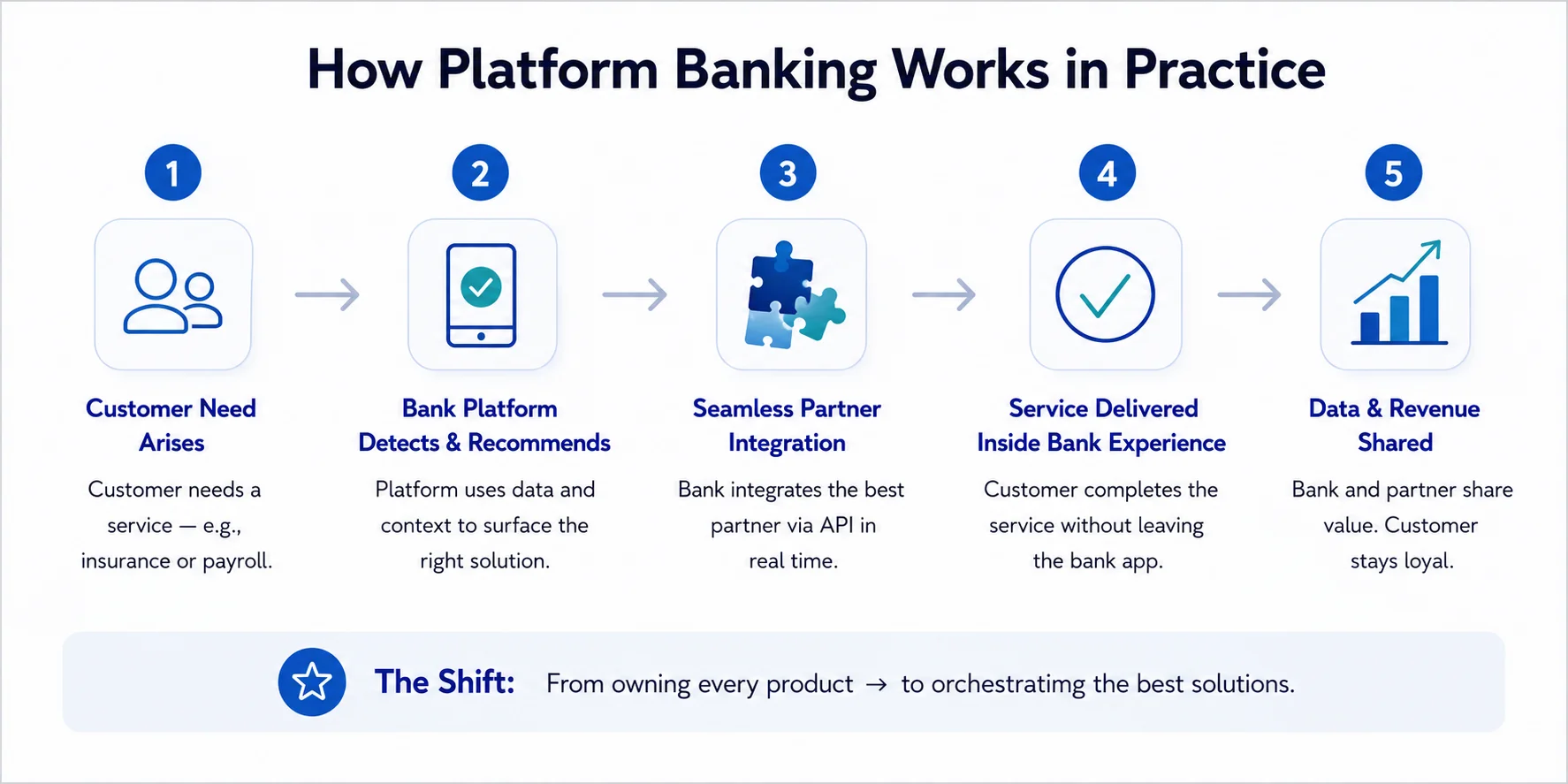
This is not digital banking (a better channel), open banking (regulated data sharing via APIs), or Banking-as-a-Service (embedding your infrastructure into someone else’s app). In platform banking, the bank is the destination, it owns the customer relationship end-to-end, sets governance rules for partners, and earns revenue across the entire ecosystem.
McKinsey’s Global Banking Annual Review 2025 puts the stakes bluntly: banks with advanced digital operating models outperform peers on revenue growth and productivity metrics. Meanwhile, the sector’s price-to-book ratio remains 67% below the average for other industries. Capital markets are voting with their wallets, and product-centricity is losing.
The Three Forces Making This Urgent
1. Margins Are Structurally Compressed
Net interest margins are under sustained pressure globally. The ECB’s 2025 Annual Report highlights those regulatory requirements, including DORA, CRR III and CRD VI, continue to rise, driving significant compliance investment. Core banking products have been commoditized. Competing on price alone is a race to the bottom that no institution can win. Ecosystem models unlock commission income, data monetization, and partnership revenues that pure banking cannot generate. The economics shift from interest-dependent to fee-based and data-driven.
2. The Competitor You Don’t See Coming
The most dangerous threat is not the bank across the street. It is the platform that already owns your customer’s daily workflow and is quietly adding financial services around it.
BCG research shows non-bank financial institutions accounted for less than 5% of global corporate and investment banking revenues in 2010. Today they exceed 15%, and BCG projects that by 2027, non-bank players will command more than 40% of total US banking-related revenues.
Alipay has replaced many bank services for hundreds of millions across Asia. DBS Singapore has built an API platform with over 1,000 partners. JPMorgan has embedded payments, lending, and treasury into the daily workflows of its business customers. The risk for incumbents is not disruption. It is relegation becoming an invisible utility while platforms own the relationship and the data.
3. Customers Expect Life-Centric Experiences
A business owner who incorporates a company digitally in ten minutes will not tolerate a 14-day account opening process. An SME CFO managing payroll, invoicing, and inventory through cloud platforms expects banking to integrate seamlessly, not exist in a separate portal they visit twice a month.
Over 90% of banking interactions are now digital. Customers give banks credit when they help manage life or business needs end-to-end. They disengage, and defect, when forced into fragmented experiences.
How We Got Here: Four Stages of Banking
| Stage | What the Bank Is | Customer Relationship |
|---|---|---|
| Branch Banking | Banking product provider via physical channels | Transactional |
| Digital Banking | Banking product provider via digital channels | Access-oriented |
| Open Banking / BaaS | Data sharer or infrastructure provider | Third-party mediated |
| Platform Banking | Ecosystem orchestrator and destination | Integrated and ecosystem-driven |
Banking-as-a-Service makes you the infrastructure behind someone else’s product. Platform banking makes you the destination. Both are valid strategies — but they require entirely different investments, capabilities, and operating models. Most banks think they are building platforms when they are actually just offering APIs. Knowing which you are building is the first strategic decision.
Three Ways to Platform Banking- Based on Where You Are Strongest
There is no single platform banking playbook. The right entry point depends on where your institution has the deepest relationships, the strongest data advantage, and the most credible partner network.
- Life Events Orchestration is the most accessible play for retail banks. Build focused experiences around high-value moments, like homebuying, relocation, starting a business and retirement. A homebuying journey might bring together mortgage, home insurance, legal, and conveyancing in one unified experience. The bank earns across the journey, not just on the mortgage. Data signals from each event deepen customer understanding, enabling proactive offers that product-only banks cannot match.
- Business Ecosystem Orchestration is the highest-value play for institutions with strong SME and corporate relationships. Become the financial operating system by integrating accounting, payroll, invoicing, trade finance, and supply chain tools. Accenture research found that embedded finance offerings to SMEs could boost global bank revenues by as much as $92 billion within three years. A business whose accounting, payments, lending, and cash management all run through one platform is structurally difficult to displace.
- The Financial Super-App is the most ambitious play, and the one that defines the next generation of leaders. Bring together financial services (banking, insurance, investments) and non-financial services (commerce, lifestyle, marketplace) into a single application under your brand. This creates the most durable competitive moat: a platform customers use daily is one they do not leave.
What It Actually Takes: Five Concurrent Investments
Platform banking is not a technology project. It is a multi-year strategic repositioning that requires five pillars to be built as a system, not in isolation.
Customer Journey Redesign means designing from the outside in. Start with customer goals, not your product catalog. New success metrics matter here: marketplace GMV, partner conversion rates, ecosystem engagement scores.
API-First Architecture means exposing core capabilities as well-documented, reliable APIs. A composable architecture layer above legacy systems enables ecosystem launches in months, not years, without touching your core. EY research found that banks rolling out new digital products monthly are the clear leaders; most others struggle with limited innovation capabilities.
Partner Ecosystem Management means building the capability to govern: partner selection frameworks, API governance, data-sharing agreements, revenue-sharing structures, and sandbox environments for rapid, secure onboarding.
Data and AI as Platform Intelligence means activating your structural data advantage. AI-powered analytics transform transaction data into contextual offerings.
Operating Model Alignment is where most strategies die. A relationship manager compensated purely on product revenue will resist ecosystem
partnerships. Compensation must blend ecosystem contribution, partner conversions, journey completion rate and ecosystem NPS, with traditional metrics. An Ecosystem Board with P&L authority must own partner selection and revenue-sharing, not a steering committee that meets quarterly.
The 18-Month Reality Check
Months 1–3: Diagnose honestly. Ask your digital leadership: “Can we onboard a non-bank partner next month?” If the answer is no, your API architecture is the first gap to close.
Months 4–6: Choose your play. Start where you have the deepest relationships. A focused life events orchestration that works is worth more than a super-app strategy that stalls at proof-of-concept.
Months 7–12: Build the composable layer. A modern digital banking platform that orchestrates legacy systems and partner APIs enables ecosystem capabilities without core replacement.
Months 13–18: Align the operating model. Redesign incentives, governance, and risk frameworks around platform economics. This is not a downstream task, it is a prerequisite.
The Technology Foundation That Closes the Gap
Most banks do not need a new core. They need an orchestration layer above it. Appzillon from i-exceed is a composable, low-code digital banking platform built for exactly this transition. It sits above legacy core systems, enabling banks to launch partner integrations in weeks via API-first architecture, sandbox governance, and AI-ready data layers, without the multi-year risk of core replacement.
Appzillon has been independently recognized by Forrester Research in The Digital Banking Engagement Platforms Landscape, Q4 2025. With 125+ banks across 25 countries, i-exceed has repeatedly helped institutions move from stranded ambition to platform execution.
In five years, every bank will claim to be a platform. The difference between those that are and those that are not will have been decided by choices made in the next 18 months.
Conclusion
To know more about how i-exceed can help with your digital banking initiatives, get in touch with us at marketing@i-exceed.com .
Frequently Asked Questions
No. Open banking is regulatory-mandated data sharing via APIs. Platform banking is a business model where the bank curates and monetizes an ecosystem of services. Open banking enables platform banking; it is not platform banking.
You do not need a full core replacement — and for most incumbent banks, you should not attempt one. The most effective path is a composable architecture layer that sits above your legacy core, orchestrating partner APIs and delivering unified experiences without touching the systems that process your daily transactions.
The “hollow out the core” approach — migrating high-value functions like digital lending or payments to a modern engine while keeping the legacy ledger for stable, low-velocity accounts — reduces blast radius and allows incremental ROI demonstration. The key is API orchestration: implementing an integration layer that connects legacy systems to modern capabilities and external partner services. This enables real-time payments, instant onboarding, and ecosystem partnerships without the operational risk of a “big bang” migration. Several next-generation core providers now offer platforms that wrap or build on top of existing cores, allowing you to launch new digital products or partner with fintechs in weeks rather than years.
Extend risk frameworks from product-level compliance to ecosystem-level governance: partner due diligence standards, data-sharing agreements with liability carve-outs, and real-time partner monitoring dashboards.
No, smaller banks can capture disproportionate rewards by embedding precision into focused ecosystem plays where they have deep local relationships or niche expertise.