
Introduction
In 2026, opening a bank account takes less time than ordering coffee. A customer taps their phone, scans their ID, takes a selfie, and within minutes they have an active account, a virtual card, and full access to digital banking services.
For customers, this feels effortless. But behind that experience sits a sophisticated, multi-layer technology stack that has taken the banking industry years to assemble and that most institutions are still racing to build.
Understanding the digital banking onboarding trends reshaping how accounts are opened is no longer a curiosity for technologists. It is a strategic imperative for every bank that wants to compete in the decade ahead. This is what that stack looks like in 2026 and how the most forward-thinking institutions are deploying it.
The 2026 Benchmark: What Zero-Friction Onboarding Actually Means
Zero-friction onboarding is not simply a fast form. It is a complete rethinking of every step between a customer deciding to open an account and having that account fully active and usable.
The benchmark for best-in-class instant account opening is rapidly shifting toward fully mobile-native, biometric-verified, KYC-compliant, and straight-through-processed flows with minimal manual intervention, no branch visit required, and no physical document handling. Critically, it must also be secure by design: speed cannot come at the cost of identity integrity or regulatory compliance.
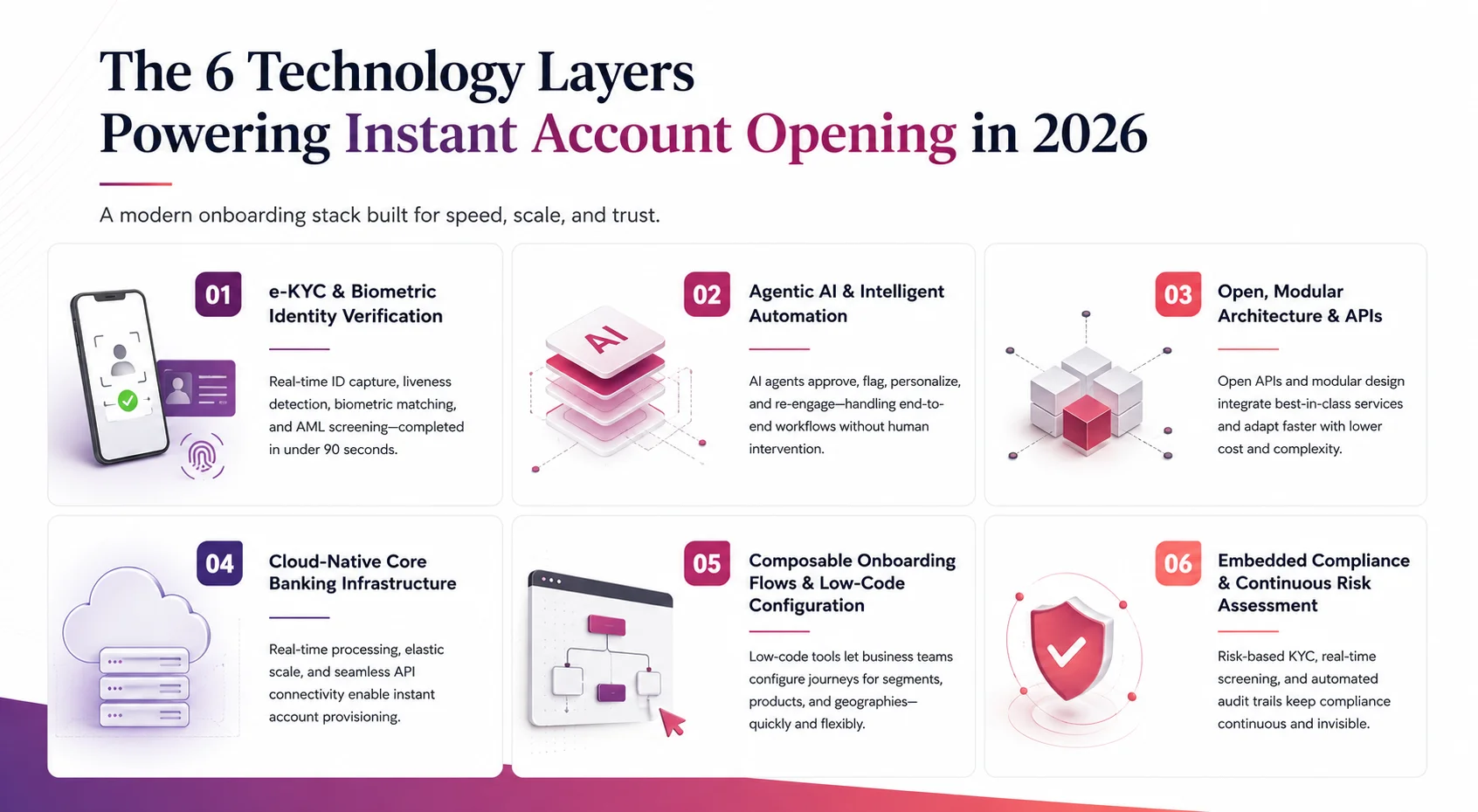
Getting there requires six interconnected technology layers working in unison.
Layer 1: e-KYC and Biometric Identity Verification
The identity verification step has historically been the biggest friction point in banking onboarding and the most significant abandonment trigger. E-KYC has resolved this by replacing manual document review with real-time automated verification.
In 2026, a customer scans a government-issued ID using their phone camera. AI-powered OCR extracts and validates the data instantly. Liveness detection confirms a live person is present not a photograph or deepfake. Biometric matching compares the live selfie to the ID image. AML and sanctions screening run simultaneously in the background. The entire sequence completes.
This is not experimental. It is the dominant standard in digital banking onboarding trends globally driven by regulatory acceptance of remote verification methods by the FCA, FinCEN, and equivalent authorities across markets, provided robust audit trails are maintained.
Layer 2: Agentic AI and Intelligent Automation
Artificial intelligence has moved well beyond fraud alerts and credit scoring in banking. Agentic AI systems are increasingly capable of handling complete onboarding workflows making decisions, triggering actions, and completing tasks with minimal human intervention, under defined governance and audit controls.
As McKinsey’s 2026 analysis of AI in banking confirms, KYC processes and customer onboarding are now largely automated through agentic AI. These systems approve straightforward applications in real time, flag edge cases for human review, personalize the onboarding journey based on behavioural signals, and send intelligent re-engagement triggers to customers who drop off mid-process.
The move from rule-based automation to agentic AI now allows most standard onboarding applications to be completed without human intervention, reserving manual review for genuinely complex or high-risk cases.
Layer 3: Open, Modular Architecture and APIs
Legacy banking infrastructure was never designed for real-time, digital-first onboarding. Monolithic core systems required weeks of development to add new workflows, made third-party integration painful, and created data silos that prevented the seamless experiences customers now expect.
Accenture’s Top Banking Trends for 2026 makes the structural case unambiguously: banks must eliminate complexity and build open, modular architectures that cut costs, boost adaptability, and turn resilience into a strategic advantage. Their research shows that banking technology costs have grown roughly four times faster than revenue over the past fifteen years, with up to 70% of IT spend now consumed by maintaining legacy systems rather than building new capabilities.
Open APIs change this equation. Banks can plug in best-in-class identity verification, fraud detection, credit scoring, and document management tools as modular components assembling a powerful onboarding stack without a full core banking replacement. Composable banking is not just a technology trend; it is the architecture that makes instant account opening commercially viable.
Layer 4: Cloud-Native Core Banking Infrastructure
Real-time account activation is the moment the onboarding promise is either kept or broken. The instant a customer completes verification, they expect an active account not a confirmation email saying it will be ready in 24 to 48 hours. Delivering on that expectation requires banking infrastructure capable of provisioning and activating accounts on demand, in real time. Legacy batch-processing platforms, which reconcile and update accounts in scheduled cycles rather than continuously, make this structurally impossible no matter how fast the front-end onboarding experience is. This is architecturally impossible on legacy batch-processing platforms.
Cloud-native core banking infrastructure enables real-time processing, elastic scaling, and the API connectivity that links onboarding systems to account management, payment rails, and card issuance all in milliseconds. Cloud-native banking is rapidly shifting from a future-state aspiration to an operational priority, increasingly becoming the infrastructure standard for institutions serious about competing on digital onboarding Speed.
Layer 5: Composable Onboarding Flows and Low-Code Configuration
Customer segments differ. Products differ. Regulatory environments differ by geography. A retail savings account onboarding flow in India has different requirements from a business account opening flow in the UAE. Institutions that hard code a single onboarding journey cannot serve the diversity of their customer base and cannot adapt when regulations change.
Deloitte’s Digital Banking Maturity 2024 research which surveyed 349 banks across 44 countries found identified hyper-personalization and seamless experience design as some of the defining differentiators separating digital banking leaders from the rest of the field. Leading banks configure distinct onboarding flows for different customer profiles, risk levels, and product types without lengthy development cycles.
Low-code and no-code workflow tools make this possible. Business teams can modify onboarding logic, update required fields, add compliance steps, and adjust user journeys in response to regulatory updates in days rather than months.
Layer 6: Embedded Compliance and Continuous Risk Assessment
Compliance is no longer a gate at the end of the onboarding journey. In 2026, it is woven throughout invisible to compliant customers and actively catching fraudulent or high-risk applications before they complete.
Risk-based KYC adjusts verification depth automatically to the customer’s profile. High-risk applicants trigger enhanced due diligence without disrupting the standard journey for the vast majority. AML watchlist screening and PEP checks occur in real time. Digital audit trails are generated automatically throughout, meeting regulatory requirements without any manual documentation overhead.
This embedded approach resolves the long-standing tension between compliance rigor and onboarding speed. Compliance becomes a structural feature of the technology stack not a friction point bolted on afterward.
The Digital Banking Onboarding Trends Defining 2026
Stepping back from the individual layers, the dominant digital banking onboarding trends of 2026 point in one clear direction: onboarding is no longer a process banks impose on customers; it is an experience they design around them.
The shift involves moving from sequential, document-heavy, human-reviewed processes to parallel, automated, intelligence-driven journeys that are adaptive, mobile-first, and compliant by architecture. Banks that have completed this transition are acquiring customers faster, losing fewer mid-funnel, and building stronger initial relationships because the first experience a customer has with their bank is one of seamless, frictionless competence.
How Appzillon by i-exceed Delivers This Stack
Every layer of the zero-friction onboarding technology stack described above is available in a single, unified platform through Appzillon by i-exceed.
Building a zero-friction onboarding stack from scratch assembling identity verification, AI workflows, open APIs, cloud infrastructure, and compliance tools from separate vendors is exactly the integration complexity that slows most banks down.
Appzillon by i-exceed removes that complexity entirely. It is a unified, low-code digital banking platform where every layer of the modern onboarding stack ships as a single, pre-integrated solution not a collection of tools that need to be stitched together.
To know more about how i-exceed can help with your digital banking initiatives, get in touch with us at marketing@i-exceed.com .