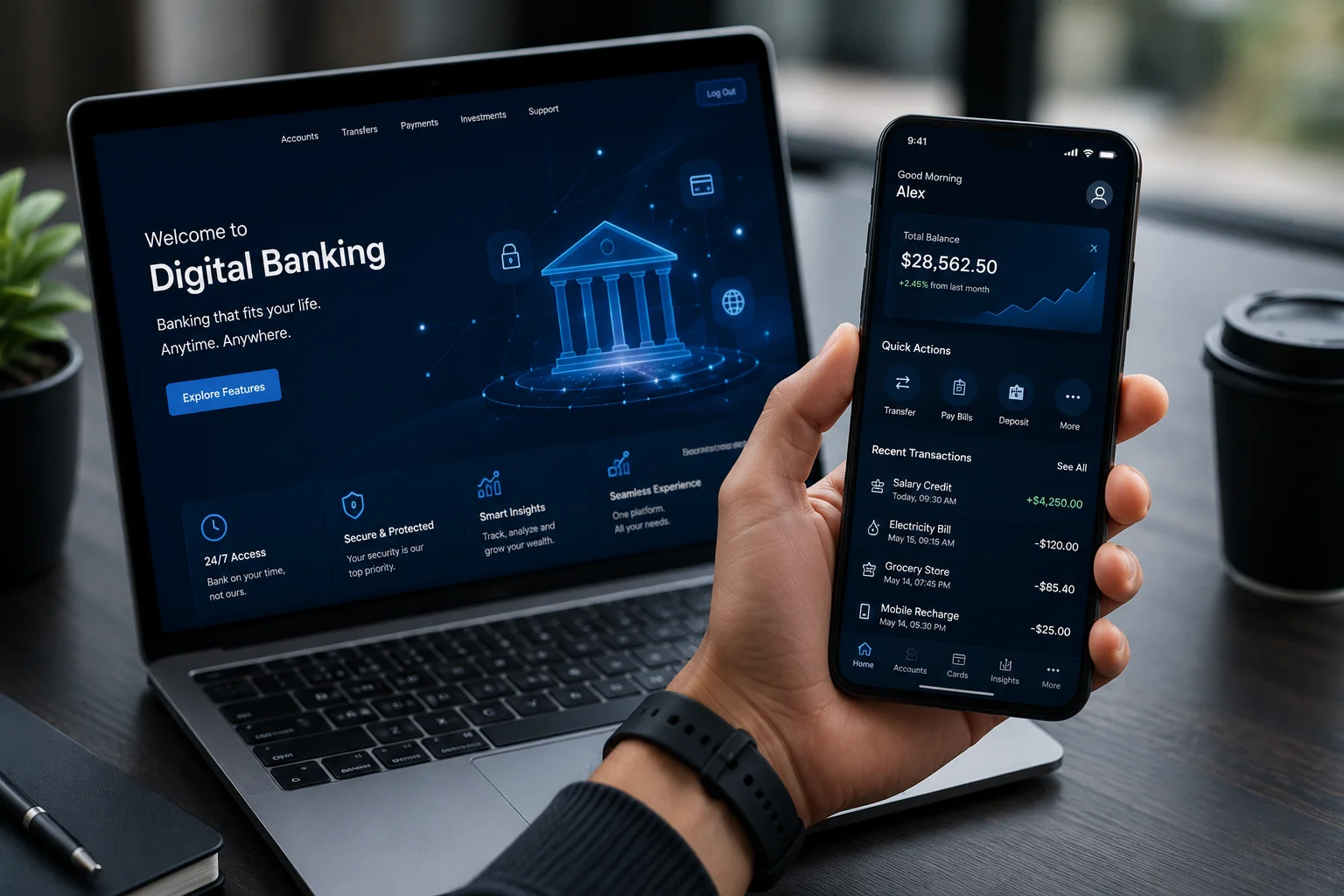
Not long ago, banking meant queuing at a branch, filling out paper forms, and waiting days for transactions to settle. Today, a customer can open an account, transfer funds internationally, invest in a fixed deposit, and dispute a transaction all from their phone, all within minutes.
Internet banking has fundamentally rewritten the relationship between people and their finances. But its advantages extend far beyond convenience. For customers, it means greater control and accessibility. For banks, it means lower costs, deeper relationships, and a genuine competitive edge. Understanding the full scope of what internet banking delivers and what it demands is now essential for any institution serious about its digital future.
1. 24/7 Access Banking Without Boundaries
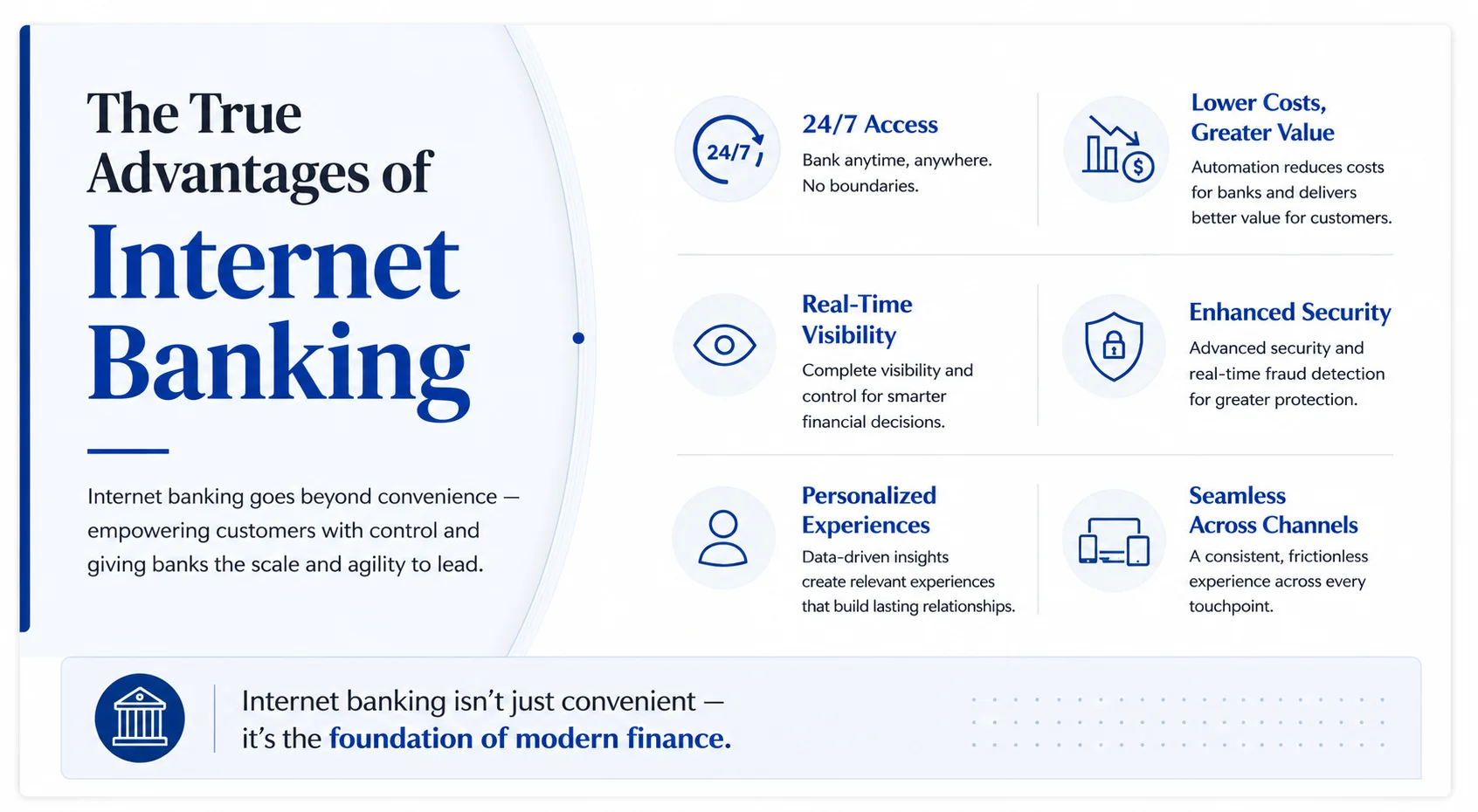
The most immediate advantage of internet banking is its availability. Customers are no longer limited to branch hours, geography, or staffing levels. Transfers can be initiated at midnight. Account balances checked during a flight. Bills paid from a different country.
This round-the-clock access is not just a convenience feature it is a fundamental shift in financial autonomy. Customers who can self-serve digitally at any time have demonstrably higher satisfaction levels and are significantly less likely to switch providers. The constraint of time and place, once a defining feature of traditional banking, has been removed entirely by well-built internet banking platforms.
2. Lower Costs for Banks and Better Value for Customers
Processing a transaction through a digital channel costs a fraction of what the same action costs when handled by a human agent or at a branch. Internet banking enables banks to automate routine operations balance inquiries, fund transfers, statement generation, payment confirmations at scale, freeing human staff to focus on complex, high-value advisory work.
McKinsey’s research on winning in digital banking notes that digitally mature banks have implemented straight-through processing that speeds up transactions by eliminating manual intervention entirely reducing IT run costs by up to 50% in some cases. Those savings can be reinvested into better product development, more competitive rates, and an improved digital experience for customers.
For customers, this translates into lower fees, faster transaction times, and increasingly, access to premium-grade financial tools that were once reserved for high-net-worth segments.
3. Real-Time Visibility and Financial Control
Internet banking gives customers something that was simply impossible in the branch-only era: a live, comprehensive view of their financial life. Every transaction, every balance movement, every pending payment visible in real time, from a single screen.
This transparency enables smarter financial decision-making. Customers can track spending patterns, set savings goals, receive instant alerts for unusual activity, and manage multiple accounts without visiting multiple institutions. Personal Finance Management tools now standard in leading digital banking platforms help customers not just see their finances but understand and act on them.
This shift from passive account holding to active financial management is one of the most significant advantages internet banking delivers and one of the most underappreciated by institutions still focused on transaction volume rather than customer outcomes.
4. Hyper-Personalization at Scale
Internet banking does not just replicate the branch experience digitally at its best, it surpasses it. Because every digital interaction generates data, banks can build a detailed picture of each customer’s behaviour, preferences, and financial needs and use that intelligence to deliver experiences that feel genuinely relevant.
McKinsey’s research on experience-led growth in banking highlights a large North American bank that redesigned over 30 digital customer journeys achieving a 25 to 50 percent increase in customer satisfaction scores. The key driver was not featuring quantity but experience quality: making digital interactions feel intuitive, timely, and personal.
Banks that deliver on personalization through internet banking do not just retain customers they deepen the relationship, increase product adoption, and generate higher lifetime value per customer.
5. Enhanced Security and Fraud Detection
A common misconception is that internet banking creates security risks that traditional banking avoids. The reality is the opposite. Modern internet banking platforms embed multi-layered security multi-factor authentication, biometric verification, real-time fraud monitoring, behavioural analytics, and encrypted data transmission that provides significantly stronger protection than branch-based processes.
Real-time alerts notify customers the moment a transaction occurs. AI-powered systems detect anomalous behaviour patterns an unusual transaction size, an unfamiliar device, an atypical location and trigger immediate review before funds move. These capabilities catch fraud earlier and more accurately than any manual process could.
The security advantage of internet banking is not incidental. It is a direct function of the data richness and automation that digital channels enable.
6. Seamless Multi-Channel Experience
The most forward-thinking banks understand that customers do not think in channels they think in tasks. They want to start an application on their phone, continue it on a laptop, and complete it in-branch without ever repeating a step.
Deloitte’s Digital Banking Maturity 2024 research which surveyed 349 banks across 44 countries found that banking leaders are increasingly focusing on seamless, intuitive digital experiences across all channels, with hyper-personalization and streamlined design emerging as the defining differentiators. The report makes clear: customers no longer evaluate their bank by its products alone. They evaluate it by the quality of its digital experience across every touchpoint.
Internet banking, when designed well, becomes the connective tissue between every customer interaction making each one feel continuous, coherent, and convenient.
7. Financial Inclusion and Accessibility
Internet banking extends financial services to segments that traditional banking infrastructure has historically underserved. Customers in rural areas, individuals with mobility limitations, small business owners managing multiple demands on their time all gain meaningful access to financial services through digital channels that physical branch networks could never efficiently reach.
This democratizing effect is one of the most socially significant advantages of internet banking. Institutions that design inclusive digital experiences expand their addressable
market while building genuine goodwill with communities that legacy banking has long overlooked.
How Appzillon by i-exceed Powers These Advantages:
Understanding the advantages of internet banking is one thing. Delivering them consistently, securely, and at scale is where most institutions struggle. That is precisely the gap Appzillon by i-exceed is built to close.
Appzillon is a low-code, AI-powered digital banking platform that enables banks to build and deploy internet banking experiences across mobile, web, and in-branch channels from a single, unified platform. It brings together:
- Omnichannel banking delivery ensuring every customer interaction is seamless whether initiated on mobile, desktop, or in-branch.
- AI-driven personalization surfacing the right product, message, or alert to the right customer at the right moment.
- Real-time transaction monitoring and fraud detection embedded security layers that protect customers without adding friction.
- Personal Finance Management tools giving customers visibility, insights, and control over their complete financial picture.
- Low-code configurability enabling banks to launch new features, modify workflows, and adapt to regulatory changes without lengthy development cycles.
For banks looking to move beyond replicating traditional banking online and toward building digital experiences that genuinely differentiate Appzillon provides the platform, the architecture, and the capability to do exactly that.
Conclusion
Ready to elevate your internet banking experience? Explore Appzillon by i-exceed.
To know more about how i-exceed can help with your digital banking initiatives, get in touch with us at marketing@i-exceed.com .