
Generative Artificial Intelligence (Gen AI) is changing the way financial institutions operate, from automating tedious banking tasks to delivering hyper-personalized customer experiences. It enables banks to take quicker decisions, while improving accuracy and reducing errors. With this, existing systems can be enhanced by automating routine tasks, faster services, round-the-clock access and banks can adapt quickly to customer needs and market changes. As banks struggle to stay competitive in an increasingly digital world, integrating GenAI is no longer a luxury- it is a necessity.
The financial technology sector is undergoing a rapid transformation and at the heart of this change lies Gen AI. This blog explores how Gen AI is influencing digital banking, the opportunities it presents, the challenges to consider and what the future holds for banking services driven by this revolutionary technology.
How is GenAI Used in Banking?
GenAI is changing the banking experience. It helps with everyday tasks like checking balance, paying bills or transferring money without having to visit the branch. It improves the quality of banking. It learns from the user’s spending habits to offer helpful financial tips.
Smart chatbots powered by GenAI are able to understand and communicate with customers just like a real person, assisting them with checking balances, transferring money, paying bills, and answering queries. These bots remember the context of conversation and provide personalized advice based on customers’ past preferences, cutting down wait times and enabling 24/7 service without branch visits. A KPMG 2023 report reveals that 66% of financial services executives believe their organizations are likely to use GenAI to use more chatbots and virtual assistants.
How do Banks Implement GenAI?
The implementation process begins with collecting and organizing large volumes of customer data, transactions, chats and preferences while ensuring security and privacy. Using this data, banks select a GenAI model, like ChatGPT, Gemini, Grok, Claude, Llama and then train it. The AI is integrated into websites, mobile apps, or chat platforms, thoroughly tested for accuracy and responsiveness. Finally, it is made available for users and the banks continue to update it in response to user feedback.
How is GenAI Transforming Banking?
GenAI is revolutionizing banking through personalized virtual assistants, smarter financial planning, automated document processing and inclusive credit scoring. It is still developing in fraud detection, although it is one of the most important factors when it comes to financial services.
1. Virtual Assistants
Unlike older, rule-based systems, today’s GenAI-powered chatbots use conversational AI, user account information and information related to handling the bank’s tech infrastructure to tailor a more personalized support approach. Some banks have already integrated AI-driven virtual assistants into their apps and websites to help users pay bills, check balances, or analyze spending. These chatbots improve user satisfaction by speeding up response times and offer 24/7 assistance without increased staffing costs.
2. Personalized Financial Planning
GenAI takes personal banking to the next level by learning from each customers’ transaction history, income, savings pattern and spending behavior. With this information, banks can then offer customized financial advice, budget recommendations and investment portfolios. Additionally, GenAI is proving invaluable in the field of tax compliance within banking by automating the preparation of tax returns and enhancing fraud detection.
3. Automated Document Processing
From KYC to loan applications, GenAI quickly scans, reads, extracts, and summarizes large volumes of documents, reducing manual effort and errors. This accelerates workflows and increases institutional agility.
4. Smarter Lending Decisions
Traditional credit scoring is often rigid and depends on fixed data sets such as credit history and income. GenAI builds thorough credit profiles, particularly for underbanked customers by analyzing alternative data, utility bills and transaction data. This is very helpful for small business owners or people new to credit. Deloitte predicts GenAI-driven real-time lending will transform banking within the next five years, boosting productivity and providing consumer-driven credit options.
5. Fraud Detection
Security is extremely crucial in banking. GenAI, although still in the learning process, enhances fraud detection by identifying abnormalities in large datasets in real time. Learning typical behavior patterns allows it to identify suspicious activities like identity theft, unusual transfers, or login attempts from strange locations. This empowers banks to proactively manage financial risks and regulatory compliance, while staying one step ahead of threats.
How can it be used in real life?
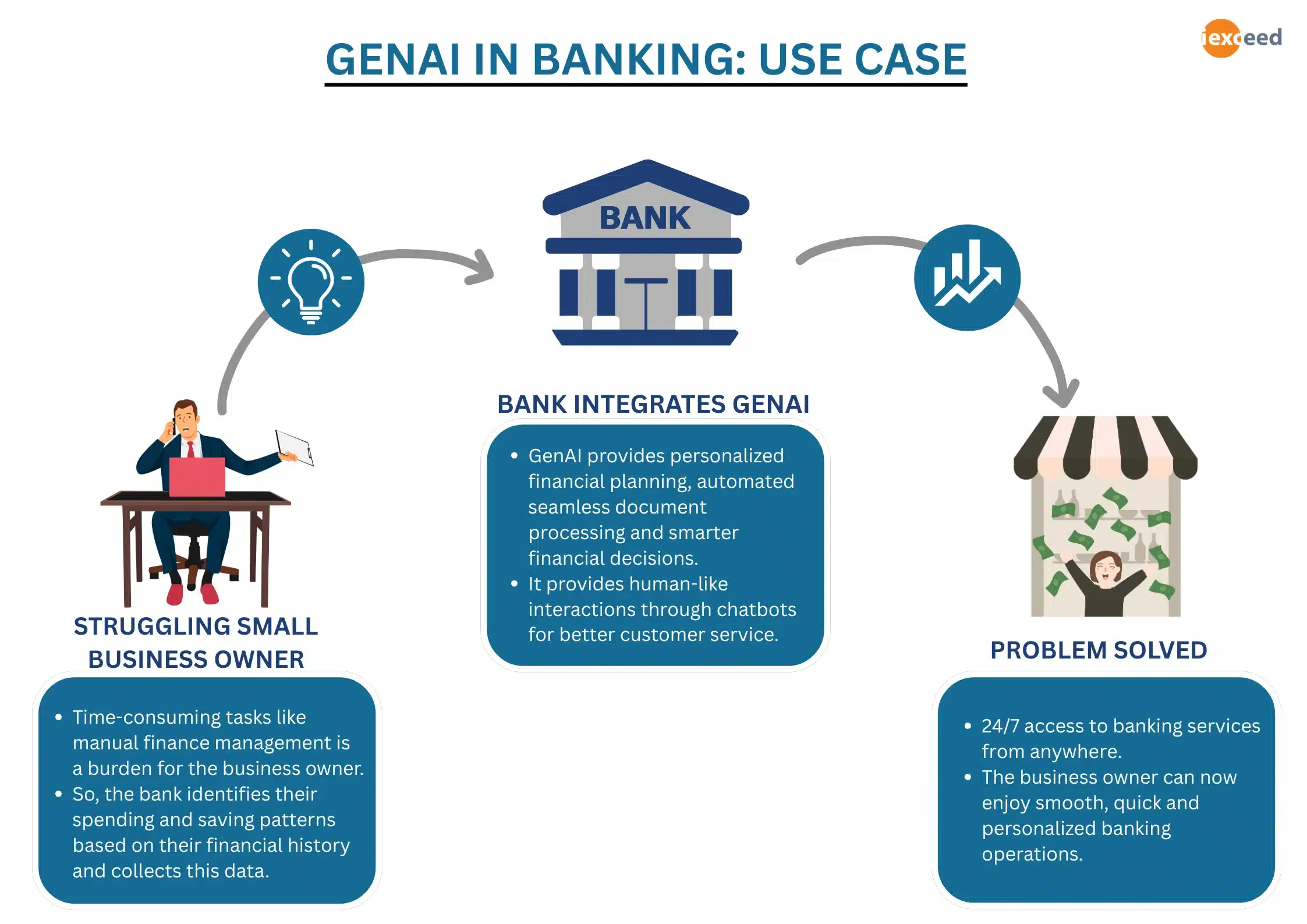
Consider a small business owner who runs an online clothing store. They handle daily orders, payments and customer service all by themselves, also managing finances like applying for loans and planning budgets. This is extremely time-consuming.
Their bank introduces a Gen AI-powered virtual assistant to their app. Now the owner simply chats with the assistant to check their balance, get payment updates and receive reminders for bills. The assistant also provides personal tips based on their business income and checks the data when applying for a loan and decides in a matter of minutes. This saves time and the owner can focus on growing their business.
What are the Ethical Concerns?
A few ethical concerns regarding GenAI in banking include biased decision-making, lack of transparency and data privacy. Building trust requires responsible use of AI and fair treatment of all customers.
- Bias and Fairness: AI models may unintentionally reflect or amplify biases present in training data, like discriminatory lending decisions or risk assessments. Ensuring fairness and inclusivity in AI algorithms is a critical ethical concern.
- Transparency by Gen AI: It can be difficult to interpret Gen AI decisions models make. Explainability is crucial for regulated industries like banking. Choices like loan rejections or fraud flags are made must be made clear to consumers, regulators, and auditors.
- Data Privacy and Compliance: Handling sensitive financial information comes with regulatory responsibilities. Banking firms using Gen AI must ensure data encryption, consent from the user and compliance with regulatory bodies like General Data Protection Regulation (GDPR).
What Lies in the Future?
GenAI is set to bring smarter, more personalized services, along with quicker decisions to banking. As technology grows, it will change how banks connect with customers, handle risks and come up with new ideas.
- AI-First Digital Banks: There will be a rise in ‘AI-Native’ banks, that is, financial institutions built from the ground up with Gen AI at their core. These banks will provide AI-driven investment strategies, offer smart contracts and autonomous financial advice with minimal human intervention.
- Advanced Wealth Management: Robo-advisors will evolve into AI-powered financial advisors capable of predicting market trends and helping users achieve long-term financial goals.
- Collaborative AI Ecosystems: To build secure and intelligent ecosystems, companies will collaborate with Gen AI developers, cloud service providers and cybersecurity firms. Seamless integration of Gen AI into multiple services will be possible through Open Banking APIs, creating an integrated financial web.
In Conclusion
Generative AI in banking is a fundamental shift in how we perceive, access and engage with financial services. It is changing the way we think about and use banking services. It brings everything from smart automation to more natural, human-like interactions, from inclusive credit scoring to next-gen fraud detection. It aims to transform banking into a more personalized, resilient and efficient industry.
But with all these exciting developments, banks have a significant responsibility on their shoulders. Thus, they need to balance innovation with ethical use of AI, consumer trust, and regulatory compliance must remain priorities as banks embrace this powerful technology. The future of banking is dynamic, and GenAI is leading the way.
To know more about how i-exceed can help with your digital banking initiatives, get in touch with us at marketing@i-exceed.com .