In 2026, trust is no longer a marketing slogan, it is a measurable performance metric. Banks are under growing pressure to demonstrate how AI systems reach decisions, especially in regulated use cases.
For years, banks have deployed artificial intelligence with an implicit bargain: we will use sophisticated models to make better decisions, and you will trust us to do so responsibly. That bargain is breaking. Regulators, customers, and boards are no longer satisfied with promises. They want proof which is verifiable, auditable, reproducible proof of how AI systems reach conclusions.
According to Alex Kwiatkowski, Director of Global Financial Services at SAS, “In 2026, trust will morph from a promise to a performance metric as banks shift from model-driven to proof-driven intelligence. Demanding verifiable transparency across every prediction, decision and interaction will become the new standard of intelligence.” This is the era of Trust as Code: the practice of embedding explainability, accountability, and verifiability directly into the architecture of AI systems.
The first wave of banking AI focused on assistance (chatbots). The second wave introduced automation (rules-based decisions). The third wave, arriving in 2026, is accountability. AI systems now make consequential decisions regarding creditworthiness, fraud, and compliance without real-time human intervention. In this environment, “the algorithm said so” is an unacceptable defense.
Why This Shift Is Unique: From AI Assistance to AI Accountability
A new phase is emerging in banking AI, centered on accountability, auditability, and human oversight. AI systems are making consequential decisions about creditworthiness, fraud detection, and compliance monitoring — often without real-time human intervention.
- The EU AI Act Deadline: Under the EU AI Act, high-risk systems face strict obligations from August 2026, and guidance and industry summaries identify credit scoring and fraud detection as high-risk banking uses. requiring mandatory impact assessments and technical documentation.
- Regulatory Anxiety: A 2026 Wolters Kluwer Banking Compliance AI Trend Report found that explainability and transparency are the most acute regulatory concerns, yet only 26.4% of institutions expressed confidence in their AI initiatives meeting these new requirements.
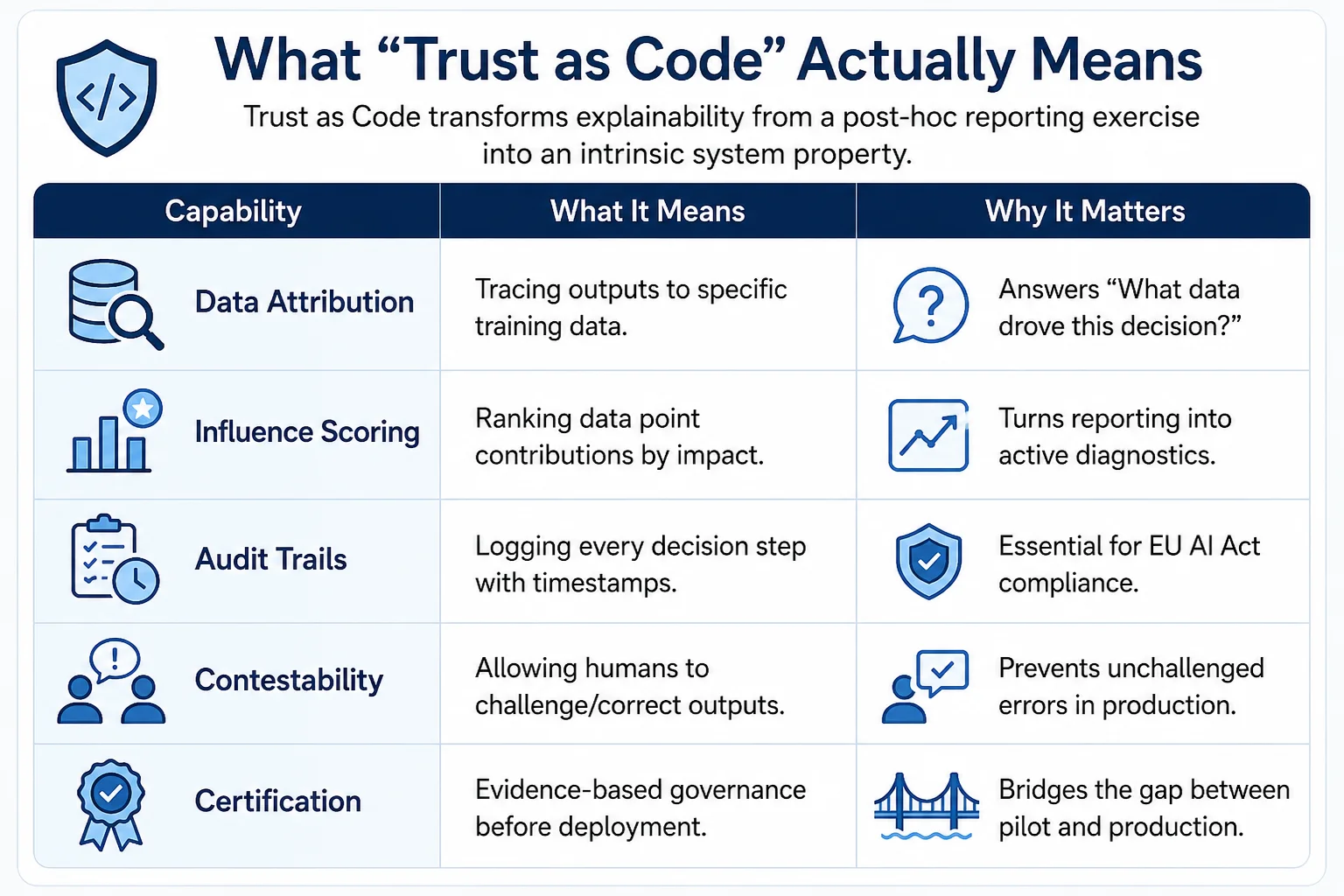
What "Trust as Code" Actually Means: An Implementation Guide
‘Trust as Code’ represents a fundamental paradigm shift. Traditionally, “Explainable AI” (XAI) was treated as a post-hoc reporting exercise, something data scientists did after a model was built to satisfy an auditor. Trust as Code flips this on its head. It treats explainability as a core functional requirement, similar to security or performance. It means that the “why” of a decision is generated at the same time as the “what,” and both are recorded as an immutable, version-controlled code artifact.
1. Moving from "Black Box" to "Glass Box"
At its core, Trust as Code is about eliminating the “black box” problem. In a black box, a loan application goes in, and a “Deny” comes out, with no visibility into the logic. A “Glass Box” approach ensures that every variable contributing to that denial is weighted and recorded. This transition requires three distinct layers of implementation:
- The Data Attribution Layer: Knowing not just what data was used, but its lineage. If a model denies a mortgage, the system must be able to prove that the decision was based on valid financial history and not a "proxy" variable (like a ZIP code being used as a proxy for race) that could lead to systemic bias.
- The Logic Transparency Layer: Using mathematical frameworks like SHAP (SHapley Additive exPlanations) and LIME (Local Interpretable Model-agnostic Explanations). While LIME helps explain a specific, local decision (e.g., "Why was this specific person's credit score 650?"), SHAP provides a global view of how the model behaves across all customers by treating every feature as a "player" in a game where the "payout" is the final prediction.
- The Governance Layer: Using open-source explainability toolkits such as IBM AI Explainability 360, banks can generate repeatable explanation artifacts and strengthen auditability for every model run. These certificates are stored in a tamper-proof audit trail, allowing regulators to see exactly how a model was behaving at, let’s say, 2:00 PM on a Tuesday three years ago.
The Strategic Defense: Why Trust Drives ROI
Many institutions view explainability as a “tax” on innovation. In reality, Trust as Code is a profit driver. When you can explain your AI, you can optimize it faster and more accurately.
Operational Efficiency and Fraud Reduction
Opaque models are notoriously difficult to debug. When a fraud detection system flags 1,000 legitimate transactions as suspicious (false positives), a “Trust as Code” approach allows investigators to see exactly which features triggered the alert. By understanding the “why,” banks can refine their models in real-time, reducing the cost of manual investigations. In fact, recent industry benchmarks indicate that AI-based fraud systems are projected to save global banks by improving detection accuracy and reducing operational friction.
Superior Model Performance
There is a common myth that explainable models are less powerful. Research has shown the opposite: by using XAI frameworks to identify and remove “noise” or biased variables, banks have seen measurable performance boosts. For example, a study using Norwegian banking data showed that Light GBM models integrated with SHAP frameworks outperformed traditional models by 17% in predictive accuracy. Transparency allows data scientists to identify “feature leakage”, where a model is “cheating” by using data it shouldn’t have access to, leading to more robust, reliable systems.
Navigating the Regulatory Landscape: The EU AI Act
The most immediate catalyst for “Trust as Code” is the EU AI Act. For the banking sector, this isn’t just about general compliance; it’s about a specific legal right granted to consumers.
If a bank cannot provide this explanation on demand, they face:
- Massive Fines: Non-compliance can result in penalties up to 7% of global annual turnover.
- Operational Bans: Regulators have the power to shut down non-transparent models entirely.
- Reputational Collapse: In an era of instant social media, "The computer says no" is no longer an acceptable customer service response.
Implementing “Trust as Code” ensures that these explanations are generated automatically, turning a potential legal nightmare into a seamless customer experience.
The "Human-in-the-Loop" Accountability
While the code provides the proof, humans must still provide the judgment. Trust as Code facilitates a more effective “Human-in-the-loop” (HITL) architecture. Instead of a human blindly approving an AI’s decision, the AI provides a “rationale dashboard.”
For a Corporate Loan Officer, this might look like:
- AI Decision: Deny Loan.
- Rationale: High debt-to-equity ratio (Contribution: 45%), volatile cash flow in Q3 (Contribution: 30%).
- Human Action: The officer can see the AI's logic, verify it against the client’s unique context, and either uphold or override the decision with a documented reason.
This synergy ensures that banks maintain the speed of AI with the ethical oversight of human experience.
The i-exceed Advantage: Governance by Design
At i-exceed, we recognize that most banks struggle not with the desire for trust, but with the infrastructure to prove it. Legacy systems were never built for the transparency requirements of 2026.
Our Appzillon digital banking platform is designed to bridge this gap. By serving over 125 banks globally, we have embedded “Trust as Code” principles into our core digital banking suites:
- Monitor transactions and behaviours in real time
- Dynamically adjust risk scores
- Compile investigation-ready case files
Industry experience with this approach suggests it can:
More importantly, it changes compliance from a cost centre to a strategic control function.
- Automated Audit Trails: Every AI-driven interaction is logged with its underlying logic, ready for regulatory review at a moment's notice.
- Explainability Dashboards: We provide visual interpretations of complex models, making them understandable for compliance officers and customers alike.
- Multi-Jurisdictional Readiness: Whether it's the EU AI Act, the UK’s FCA principles, or UAE's AI ethics guidelines, our solutions are pre-configured to meet the world’s most stringent transparency standards.