
AI, or Artificial Intelligence, has become the backbone of many transformative changes in banking and finance. Simply put, AI refers to the simulation of human intelligence in machines that are programmed to learn, reason, and self-correct. As it influences the everyday decisions of individuals everywhere, AI is now becoming a major catalyst for enhancing efficiency, accuracy, and customer experience in finance and banking. With investments in AI rising sharply, financial institutions are finding AI indispensable for staying competitive in a digital-first world. But how exactly is AI transforming banking and finance?


The Rise of AI in Finance
AI’s rise in finance has accelerated as traditional banks strive to keep up with digital-first challengers. A McKinsey study revealed that large banks were 40% less productive than digital-native firms, highlighting the need for innovation. Emerging fintech startups have led the way in AI adoption, prompting incumbent banks to invest in AI technologies to remain competitive. The rapid adoption of AI in finance is not only driven by competition among banks but also by strategic partnerships. For instance, Citi’s collaboration with Google Cloud exemplifies how financial institutions can leverage technology giants to modernize their infrastructure and deliver innovative services. Such alliances address scalability and efficiency challenges, allowing banks to remain competitive in a digital-first world. This shift highlights the growing trend of banks looking beyond internal capabilities to achieve technological transformation. In investment banking, AI-powered natural language processing (NLP) has been used to analyze vast datasets, helping firms make smarter investment decisions. This trend is now expanding to broader digital banking, where customers expect seamless, AI-driven experiences. From virtual assistants to personalized financial insights, AI is helping banks meet growing consumer expectations for intuitive, digital-first services. Additionally, AI’s combination with automation offers even more benefits. An article by IBM notes that AI-enhanced robotic process automation (RPA) is improving processes like customer data validation for regulatory compliance, streamlining operations, and ensuring greater accuracy.AI-Powered Decision-Making Drives Customer-Centricity
Artificial intelligence is changing the decision-making capabilities to a new level in banking by providing actionable insights derived from massive datasets. AI enables banks to extract actionable insights from millions of transactions, empowering them to anticipate customer needs like mortgage readiness or tailored savings plans. Banks can now predict customer needs—such as mortgage readiness or investment preferences— by leveraging machine learning algorithms before the customer even expresses them. These enhanced insights feed directly into customer-centric strategies. For instance, personalization engines in retail banking now use real-time data to recommend tailored savings plans or credit card options, significantly improving customer satisfaction. Moreover, advanced tools like sentiment analysis in customer service channels help identify pain points and adjust communication strategies, ensuring a positive and engaging user experience. AI’s role in decision-making not only transforms individual customer interactions but also drives strategic initiatives like risk management and revenue optimization. By integrating AI-driven insights into their operations, banks can align their goals with evolving customer expectations, ensuring sustained loyalty and trust.AI’s Role Across Banking Departments
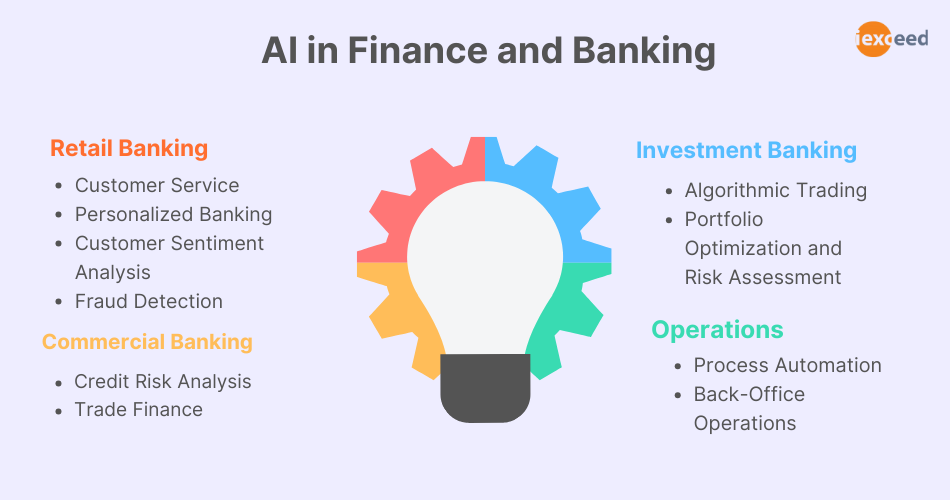
Retail Banking
- Customer Service: AI chatbots can manage routine questions and troubleshooting 24/7, allowing banks to serve customers without the wait. This has set a new standard in customer expectations, especially in fast-paced, always-on digital environments.
- Personalized Banking: By analyzing spending habits, savings patterns, and more, AI algorithms can provide highly targeted financial products. This approach not only meets but often anticipates customers’ needs, adding a layer of service quality that was once unimaginable.
- Customer Sentiment Analysis: Banks can now use AI to track and analyze customer feedback from social media and reviews to understand sentiment shifts, refining services to meet evolving expectations.
- Fraud Detection: AI’s pattern recognition capabilities help prevent fraud by identifying unusual transaction behavior in real-time, enhancing the security of digital banking.
Commercial Banking and Risk Management
- Credit Risk Analysis: Through AI, banks can more accurately assess creditworthiness by examining extensive data points, from credit history to broader economic indicators, reducing the chances of bad loans and supporting sound lending practices.
- Trade Finance: AI also facilitates trade finance by automating document verification and assessing transaction risks, which not only speeds up processes but also minimizes errors that could lead to financial loss.
Investment Banking
Investment banking has been at the forefront of adopting AI technologies to streamline operations, enhance decision-making, and improve client services. The continuously flowing news of bank-fintech collaboration reflects the growing trend of using AI to offer tailored investment strategies, driven by algorithms capable of analyzing vast datasets with precision. In addition, banks like Deutsche Bank have leveraged AI with their collaboration with NVIDIA marking a significant step forward in deploying AI and machine learning. Such innovations enable traders to efficiently manage risks and simulate complex scenarios at scale, while also reducing energy consumption highlighting AI’s risk management and trading capabilities.Operations
AI’s transformative role in banking operations goes beyond automation. By incorporating AI-driven solutions, banks are achieving greater accuracy, scalability, and efficiency in their back-office processes. For example, process automation using AI can handle tasks like data reconciliation, settlements, and regulatory reporting with minimal human intervention. This not only reduces operational costs but also ensures compliance with evolving regulations. The emphasis on sustainable operations is also evident. The potential of AI to optimize workflows is growing while minimizing energy use, signaling a broader industry trend toward more environmentally responsible practices. In back-office operations, AI significantly enhances data integrity and reduces manual errors through tools like robotic process automation (RPA), ensuring consistency across all operational activities.Core Use Cases of AI in Finance

- Fraud Detection and Data Protection
- Personalized Financial Advice
- Automated Trading
- Risk Management