
When most people think of bank security, they picture vaults, guards, and encrypted apps. But the most dangerous threats to your money today aren’t physical — they’re digital, invisible, and quietly evolving. Cybersecurity in banking has entered a new era, one defined not just by hackers breaking through firewalls, but by a hidden risk layer that most institutions — and customers — never see coming.
Why This Topic Is Unique
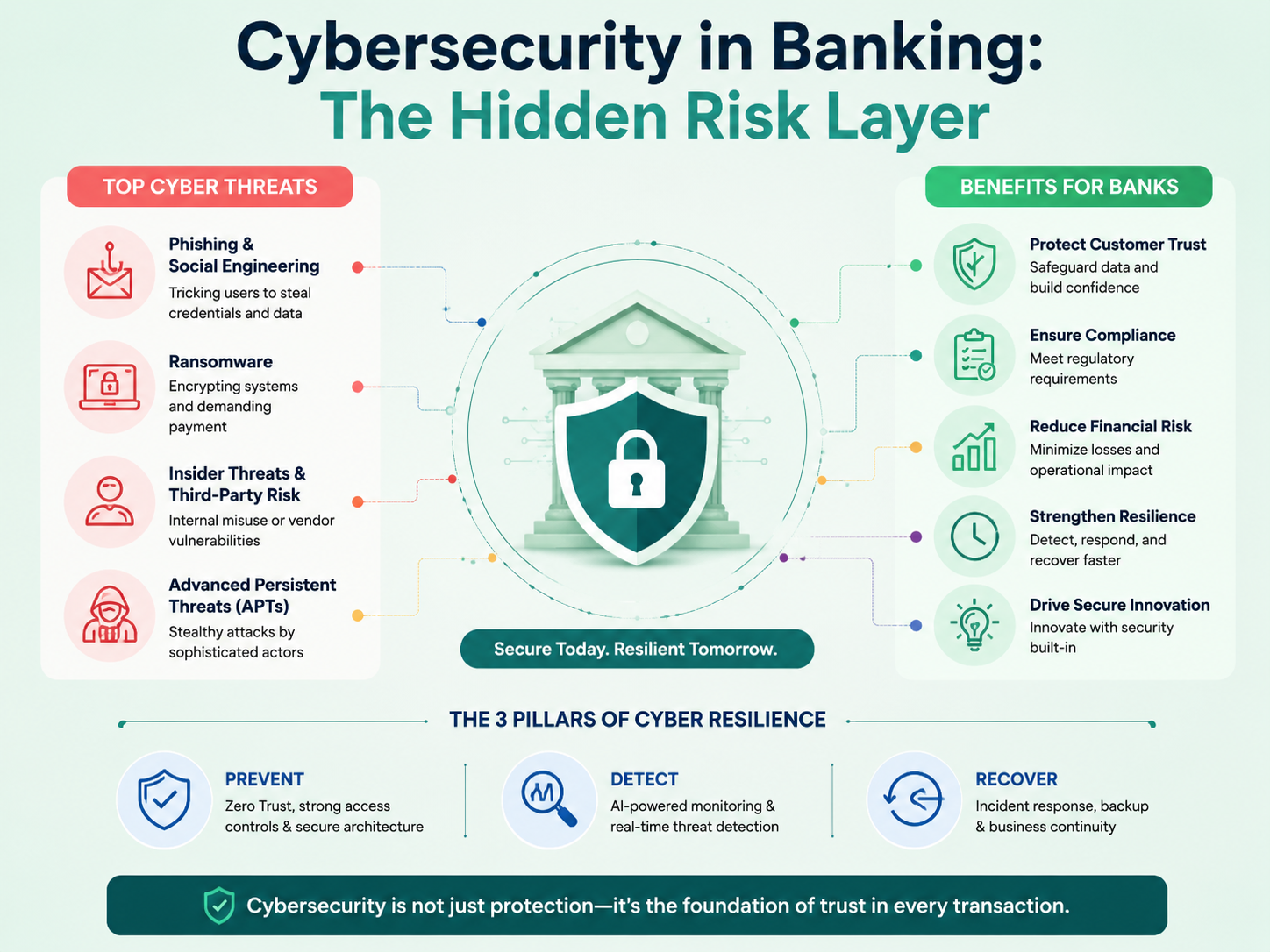
Most cybersecurity content covers surface-level threats: phishing emails, weak passwords, malware. This blog goes deeper.
The “hidden risk layer” refers to the compounded, interconnected vulnerabilities that sit beneath conventional security measures — the supply chain backdoors, AI-weaponised social engineering, insider threat blind spots, and regulatory compliance gaps that traditional defences are simply not built to stop.
What makes this uniquely alarming is the scale. According to IBM’s 2025 Cost of a Data Breach Report, the average cost of a data breach for U.S. companies hit an all-time high of $10.22 million in 2025 a 9% jump year-over-year. And across 600 global organisations studied, nearly two-thirds said they were still recovering from a breach at the time of the report.
Banks aren’t just losing money. They’re losing trust, and trust, once broken, rarely fully returns.
1. The Threat Landscape Has Exploded
Financial institutions are no longer dealing with isolated incidents. The volume and sophistication of attacks targeting banks have accelerated sharply, with DDoS campaigns and data breaches rising in parallel. What was once a manageable risk has become a systemic pressure — one that strains security teams, disrupts customer services, and demands constant vigilance across every layer of a bank’s digital infrastructure.
2. The AI-Powered Attack Layer
Artificial intelligence has become a double-edged sword in banking security. While banks use AI for fraud detection, cybercriminals are using it to craft attacks that are faster, more convincing, and harder to detect.
Consider this: In January 2024, a finance worker at a Hong Kong firm was tricked into transferring $25 million after deepfake technology convincingly impersonated the company’s CFO during a live video call. a stark demonstration of how AI has moved from science fiction to active financial weaponry. Modern voice-cloning systems can now generate convincing audio replicas from minimal source material, creating ideal conditions for high-value social engineering attacks targeting bank executives and finance teams.
AI-generated phishing emails no longer contain obvious typos or grammatical errors. They are contextually accurate, culturally tailored, and scraped from real professional profiles. This is phishing, upgraded.
3. Third-Party Vendor Risks, The Backdoor Nobody Watches
One of the most overlooked hidden layers is third-party vendor exposure. Banks don’t operate in isolation they rely on dozens of software vendors, cloud platforms, and data processors. Each one is a potential entry point.
The ABA Banking Journal highlighted this clearly: ransomware attacks hitting supply chain vendors are projected to “cause all kinds of grief, particularly breaches containing material customer information.” In December 2023, a single third-party provider’s ransomware attack compromised around 60 credit unions simultaneously a cascading failure that no individual bank’s internal security could have prevented.
As regulators make clear: “Engaging a third party does not diminish a bank’s responsibility to operate in a safe and sound manner.”
4. Insider Threats — The Enemy Within
Not every breach comes from outside. Insider threats — whether malicious employees, compromised credentials, or simple human error — are a growing and often underestimated vector. IBM’s 2025 research confirms human error as a leading contributor across data breaches studied globally. In some cases, cybercriminals actively recruit bank employees to expose internal security setups, turning trusted insiders into unwilling attack surfaces.
The challenge is visibility. Banks invest heavily in perimeter defences but often lack the internal monitoring tools to detect unusual behaviour from within — making insider threats one of the hardest risks in the hidden layer to address.
5. Regulatory and Compliance Blind Spots
Despite frameworks like NIST, ISO/IEC 27001, and Zero Trust Architecture being available, adoption remains inconsistent across the industry. The European Central Bank’s 2024 Cyber Resilience Stress Test revealed that a significant portion of assessed banks showed material weaknesses in their ability to recover after a cyberattack. Compliance is not the same as security — and many banks are learning this the hard way.
Meeting a regulatory checklist does not mean a bank can withstand a real-world attack. True resilience requires continuous testing, adaptive response planning, and security embedded into every layer of operations — not just the ones auditors inspect.
Benefits of Understanding This Hidden Risk Layer
- Proactive Defence: Knowing where hidden risks exist allows CISOs and IT teams to prioritise resources beyond surface-level tools.
- Regulatory Readiness: Understanding the full threat map helps banks align with evolving regulatory requirements before penalties hit.
- Customer Trust: Banks that communicate their cybersecurity posture effectively retain customer confidence — a competitive advantage in the digital era.
- Reduced Recovery Costs: IBM's data shows that organisations deploying AI-driven security tools saved significantly on breach costs compared to those that didn't.
- Vendor Accountability: Awareness of third-party risk leads to stronger contract enforcement, regular penetration testing, and supply chain audits.
The greatest cybersecurity risk in banking today isn’t the one you’re watching for — it’s the one quietly growing behind it. The hidden risk layer is real, measurable, and accelerating. Banks that treat cybersecurity as a compliance checkbox will continue to pay the price. Those that treat it as a living, adaptive strategy will be the ones still standing.