
i-exceed-anniversary-desktop-img
img

7 Trends US Credit Unions Can’t Afford to Overlook

7 Trends US Credit Unions
Heading into 2027, credit unions face a compound challenge: compete with banks and fintechs on digital experience, retain deposits, adopt AI responsibly, and stay ahead of fraud, all without losing the community trust that defines them.
These seven trends are interconnected, not independent. Deposit growth depends on member experience. Member experience depends on data. Data governance underpins responsible AI. AI can either strengthen or undermine fraud prevention. Understanding those connections separates a reactive roadmap from a strategic one.

Are You Ready? A 2027 Readiness Check
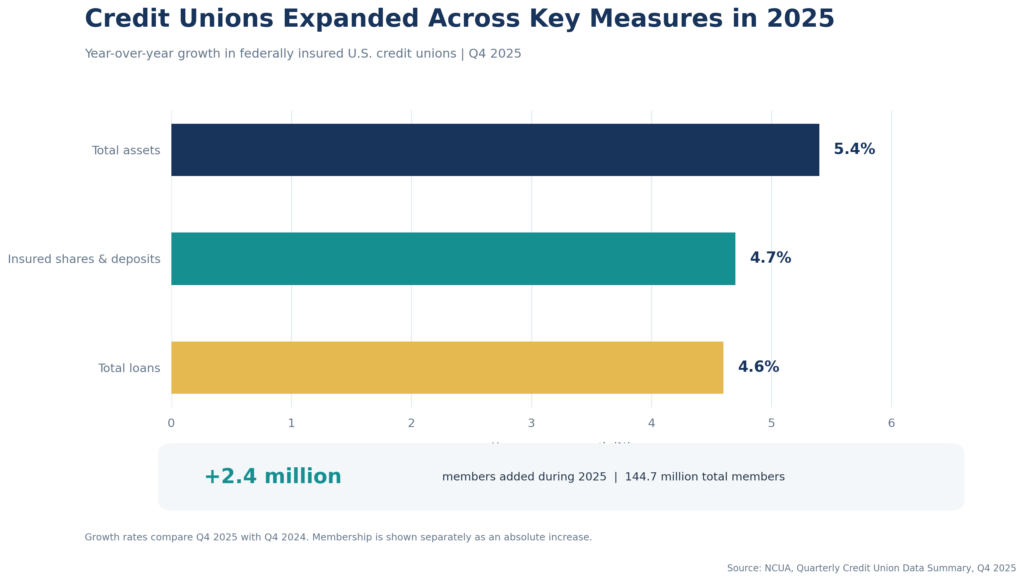
Infographics showing growth of credit unions over the years.

1. Deposit Growth Is a Competitive Battleground Now

The deposit environment has shifted in ways credit unions cannot afford to wait out. In early 2024, many online FDIC-insured banks were offering 5% APY or more on high-yield savings accounts. Members who moved during that cycle may now be settled into competing platforms.
The TruStage Credit Union Trends Report (April 2026) forecasts savings growth reaching 7.0% by 2027. Members are staying. But with deposit costs rising alongside rates, net interest margin pressure remains a structural challenge. Members weigh convenience, trust, service quality, and the ease of opening and funding an account. Friction of any kind tips the balance toward a competitor.
What credit unions should do: Review digital account-opening completion and funding rates. Identify where members drop off. Assess whether instant ACH or card funding is available at opening, and test the experience from the member’s perspective.

2. Generic Digital Banking Is No Longer Competitive

Access to digital banking is now a given. What determines competitive standing in 2027 is relevance. Members can already log in, check balances, and transfer funds. What they increasingly expect is an experience that actually knows them.

Credit unions often hold transaction history, loan behavior, life-event signals, and service interactions, but do not consistently use them to tailor communication or surface relevant products. That gap is exactly where fintech competitors continue to gain ground.
Personalization means using what a credit union already knows to make the right offer, at the right time, through the right channel.
What credit unions should do: Identify two or three member segments with distinct needs or behaviors. Design a targeted communication or offer for each, measure response and conversion, and refine the approach before expanding it.

3. AI Without Data Governance Is a Liability, Not an Advantage

AI is already reshaping the competitive economics of financial services. McKinsey estimates generative AI could deliver an additional $200 billion to $340 billion in annual value across global banking, equivalent to 2.8% to 4.7% of industry revenue. The question for credit unions is not whether to use AI. It is whether they use it deliberately or reactively.

A September 2026 study reported by The Financial Brand, based on interviews with 46 credit-union executives through Stanford Graduate School of Business, found a significant gap between confidence and readiness. Executives rated AI readiness 3.3 out of 5, but frontline data visibility 3.0 and workflow support 2.8. Self-assessed readiness correlated only weakly with data foundations. Meanwhile, 45 of 46 executives said control of member data was important, while describing fragmented systems and uncertainty over data ownership.

What credit unions should do: Audit current and planned AI use, including features embedded in vendor platforms. Document the data used, who reviews outputs, how errors are caught, and how members can seek recourse. Start with one or two lower-risk use cases: member-service automation, unusual-transaction flagging, or campaign targeting.

4. Faster Payments Are No Longer Optional Infrastructure

FedNow reached 607 participating financial institutions by March 2024 and more than 700 by May 2024. The Federal Reserve also reported that, in 2023, 86% of businesses and 74% of consumers said they used faster or instant payments, while 74% of businesses and 79% of consumers looked to their financial institution to provide these services.
By 2027, instant-payment expectations will continue to rise. The question is whether credit unions can meet them with a reliable receive, and eventually send, capability.
Faster payments affect more than the payment rail:
What credit unions should do: If not live on FedNow for receive, establish a timeline. If already receiving instant payments, assess whether send is on the roadmap. Update fraud-monitoring thresholds and operational procedures to reflect the speed and finality of instant transactions.

5. The Fraud Threat Has Fundamentally Changed

Consumers reported losing more than $10 billion in the previous years with the first year reported losses exceeding that threshold. Reported losses rose 14% from 2022 and the largest reported-loss categories were investment scams and imposter scams.
Generative AI is lowering the cost of creating convincing voice, video, and identity-based fraud. By 2027, faster payments will narrow the intervention window further. Credit unions that have not updated their fraud controls for this environment are carrying material and growing risk.
Credit unions face a real tension: stronger controls create friction for legitimate members, while weaker controls expose members and the institution. The goal is smarter detection, not more friction.
What credit unions should do: Review authentication controls for account opening and high-value transactions. Run realistic social-engineering simulations for staff. Update detection rules and monitoring thresholds for digital transaction speed and AI-enabled impersonation. Finally, invest in member education on current scam tactics.

6. Revenue Diversification Must Be Earned, Not Extracted

Margin pressure remains a persistent challenge as funding costs and competition for deposits and loans intensify. Revenue diversification is necessary. But the wrong kind of diversification is worse than none, because it trades short-term revenue for long-term trust.
Fee income that feels punitive, embedded products that prioritize margin over member value, or partnerships that obscure accountability can erode the trust that is a credit union’s core competitive asset.
The strongest opportunities expand genuine member value: financial-wellness tools, insurance that fills real gaps, business services for underserved owners, or digital capabilities that reach new segments.
Strategic partnerships can accelerate capability, but require clear expectations on accountability, data handling, and what happens when performance falls short.
What credit unions should do: Test every new revenue initiative against three questions: Does it address a genuine member need? Can it be delivered reliably at scale? Does it align with the credit union’s mission?

7. Efficiency That Hurts Members Is Not Efficiency

Every credit union leadership team is under pressure to do more with the same resources. But efficiency pursued without member impact in mind can quietly erode the relationship credit unions are built on.
If self-service automation makes it harder to reach a person when a member needs one, the efficiency gain comes at a hidden cost. The right question is not ‘How do we cut costs?’ but ‘How do we free capacity for the work that matters most?’
Automating document processing, digitizing manual workflows, and reducing inbound calls through proactive communication can free staff for financial counseling, complex problem-solving, and relationship-building that a purely digital competitor cannot replicate.
Track both the operational metric (time saved, cost reduced) and the member metric (experience improved or degraded). Both must pass before an initiative is called a success.
What credit unions should do: Identify the five to ten processes that consume the most staff time or create the most member friction. Prioritize automation that improves the member experience, and measure both operational and member-experience outcomes.

Common Pitfalls to Avoid

Even with the right intentions, credit unions repeatedly make the same planning mistakes. The most costly ones:

One Priority That Unlocks the Rest

If a credit union can make only one foundational investment in 2027, make it the data layer. Everything else depends on it.
AI needs clean, accessible data. Personalization needs member insight. Fraud prevention needs timely transaction data. Faster payments need operational systems that can act in near real time.
The most durable competitive advantage for a credit union in 2027 will not come from any single product or feature. It will come from unified, well-governed member data that helps staff and systems see, trust, and act on the right information at the right moment.

Build a Plan Around What Matters Most

Three questions can focus the work:
Credit unions that answer those questions honestly, invest with discipline, and measure outcomes rather than activity will be better positioned for 2027 and the years that follow.
To know more about how i-exceed can help with your digital banking initiatives, get in touch with us at connect@i-exceed.com .

Subscribe to our Newsletter

    Share the blog

    Share on facebook
    Share on twitter
    Share on linkedin
    Share on email

    Recent Posts