
For years, artificial intelligence in banking has operated as an assistant – useful, but ultimately dependent. Chatbots answered questions, models flagged risks, and robo-advisors suggested actions. But the final decision always rested with a human.
That model is now being redefined.
Across the industry, a new class of systems is emerging – agentic AI. These are not just tools that inform decisions, but systems that can plan, reason, and act. In practical terms, this means AI that can execute trades, resolve compliance exceptions, manage liquidity, and serve customers, often without waiting for human intervention.
A growing number of leading institutions are already moving in this direction. What was experimental even two years ago is now entering production. The shift is not incremental. It is structural.
The Strategic Context: Why This Moment Matters
Across global advisory and research communities, a consistent view has emerged: AI in banking is moving from model-driven insights to decision-driven systems.
The distinction is critical.
- Traditional AI identifies patterns
- Advanced AI recommends actions
- Agentic AI executes outcomes
This transition, from assistance to autonomy – is where the real economic value lies. Productivity gains from agentic AI implementations have been significant, with institutions reporting meaningful improvements across key workflows.
But the importance is not just efficiency. It is control over decision velocity. In markets where timing defines competitiveness, like treasury, lending, compliance and customer engagement, speed is no longer an advantage. It is the baseline.
The Problem: Where Banking Still Slows Down
Despite years of digital investment, most banks still face a structural bottleneck: the gap between insight and execution.
Three friction points persist:
1. Exception-heavy processes
Automation works well for standard scenarios. But banking is filled with edge cases -trade mismatches, KYC anomalies, regulatory exceptions- that still require human judgment.
2. Compliance overhead
AML and KYC systems generate high false positives, forcing teams into manual review cycles that slow operations and increase costs.
3. Reactive customer engagement
Even digital banking remains largely reactive. Customers act; banks respond. The system does not anticipate, optimize, or intervene in real time.
The Shift: What Agentic AI Changes
Agentic AI addresses this gap by introducing decision-making capability into workflows.
Instead of stopping at “what should be done,” these systems move to “do it within defined boundaries.”
Think of it as bounded autonomy:
- Humans define intent, policy, and guardrails
- AI executes continuously within those parameters
This is not about removing control- it is about redefining where control sits.
Real-World Applications: Where It’s Already Working
1. Trade Operations and Reconciliation
At institutions like Goldman Sachs, AI agents are being deployed to handle trade accounting and reconciliation, areas traditionally resistant to automation.
These systems:
- Analyse transaction flows
- Match records across systems
- Resolve discrepancies using reasoning logic
What once required teams of analysts can now be handled in near real time, with humans stepping in only for true exceptions.
2. Compliance and Risk Monitoring
Compliance is shifting from periodic review to continuous intelligence.
Agentic AI systems:
Agentic AI systems:
- Monitor transactions and behaviours in real time
- Dynamically adjust risk scores
- Compile investigation-ready case files
Industry experience with this approach suggests it can:
More importantly, it changes compliance from a cost centre to a strategic control function.
- Substantially reduce investigation effort
- Significantly lower false positives
- Improve regulatory responsiveness
More importantly, it changes compliance from a cost centre to a strategic control function.
3. Proactive Customer and Treasury Management
The most visible impact is on customer experience.
Agentic AI enables:
- Auto-hedging based on FX exposure thresholds
- Smart liquidity movement across accounts
- Pre-emptive credit offerings based on cash flow signals
This is a shift from service to stewardship.
Customers no longer manage finances alone – the system actively optimizes outcomes on their behalf.
The Use Case: From Digital Banking to Autonomous Banking
Consider a mid-sized corporate bank serving SMEs.
Today’s state:
- Onboarding takes days or weeks
- Treasury decisions are manual
- Compliance reviews delay transactions
With agentic AI:
- Onboarding becomes near real-time with automated verification
- Liquidity is continuously optimized across accounts
- Compliance runs in the background with dynamic risk scoring
- Relationship managers focus on advisory, not administration
The result is not just efficiency – it is a fundamentally different operating model.
The Solution: Building Agentic Capability, the Right Way
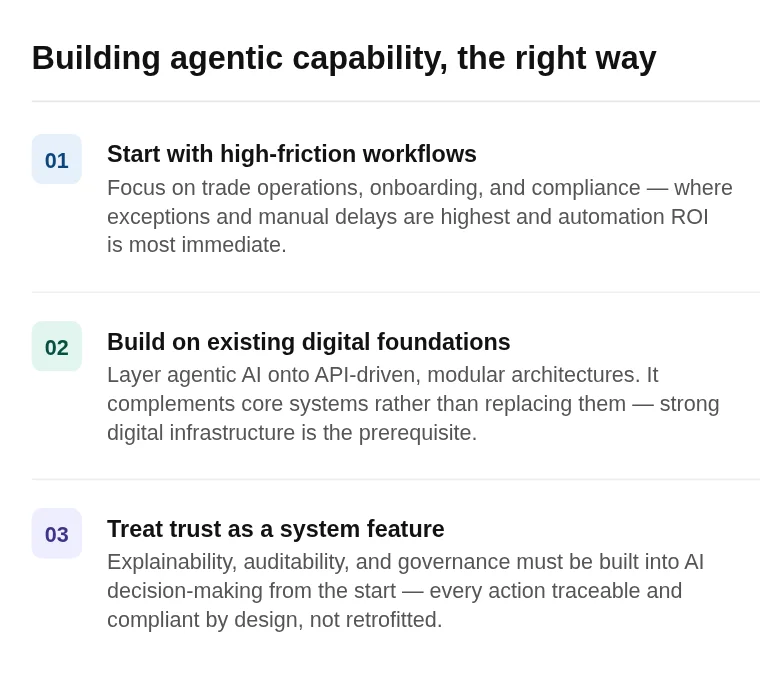
The transition to agentic AI does not require a complete rebuild. In fact, the most effective approaches are incremental and layered.
Three principles stand out:
Three principles stand out:
1. Start with high-friction workflows
Focus on areas where exceptions, delays, and manual effort are highest – trade operations, onboarding, compliance.
2. Build on existing digital foundations
Agentic AI works best when layered onto API-driven, modular architectures. It complements, rather than replaces, core systems.
3. Treat trust as a system feature
As highlighted by firms like Accenture, explainability, auditability, and governance must be built into AI decision-making.
This is where the idea of “trust as code” becomes critical – ensuring every AI action is traceable, explainable, and compliant by design.
The Bigger Picture: A Shift in Banking Economics
The implications go beyond operations.
Agentic AI is reshaping:
Agentic AI is reshaping:
- Cost structures (through automation of complex work)
- Revenue models (through proactive engagement and cross-sell)
- Customer expectations (toward real-time, intelligent service)
Early evidence suggests that banks adopting AI-led operating models stand to capture disproportionate value, not just in efficiency, but in market positioning.
Conversely, those that delay risk becoming infrastructure providers in ecosystems controlled by more agile players.
Closure: The Decision Ahead
Agentic AI is not about replacing bankers. It is about redefining the role of the bank itself.
| From | To |
|---|---|
| Processing transactions | Managing outcomes |
| Responding to customers | Anticipating and acting on their needs |
The question for leadership is no longer whether this shift will happen. It is already underway. The real question is more strategic:
Will your institution design the systems that make decisions - or operate within decisions made by others?
Because in the age of agentic AI, competitive advantage will not come from having intelligence. It will come from acting on it – faster, better, and at scale.